
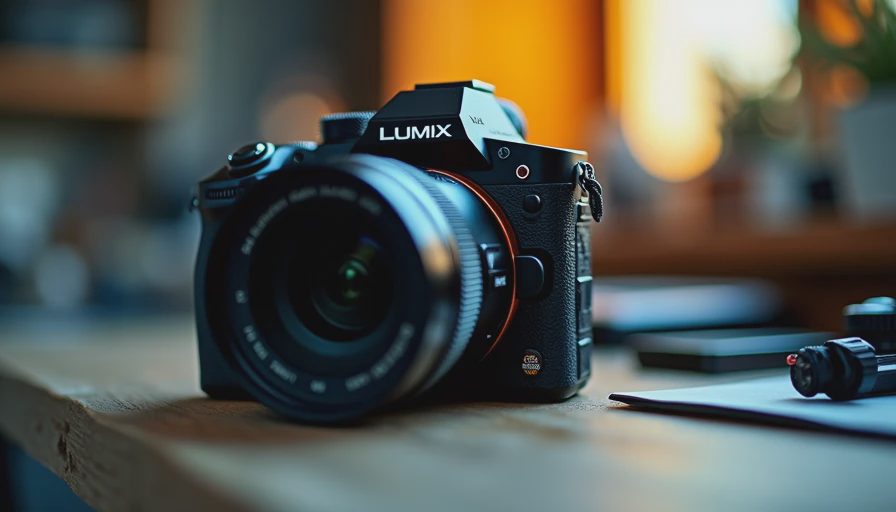
If you are asking does the Lumix S9 have IBIS, the short answer is yes. Panasonic's compact full-frame mirrorless camera includes in-body image stabilization, commonly called IBIS, through a sensor-shift system. That matters when you are shooting indoors, walking around at dusk, or recording handheld video without wanting to carry a tripod everywhere.
The more useful question is whether the stabilization is good enough for the way you actually shoot. IBIS can help you use slower shutter speeds for still photos and smooth out ordinary handheld movement. It cannot freeze a moving child, replace a gimbal for walking footage, or rescue every shaky clip. This is where the spec sheet stops helping.
The three things that actually matter
First, the S9 stabilizes the sensor rather than relying only on a stabilized lens. That means you can get stabilization with compatible lenses that do not have their own optical stabilizer. A small prime lens, such as a 35mm or 50mm option, becomes more practical for evening street photos and casual indoor shots.
Second, IBIS is most valuable for camera movement, not subject movement. If you are photographing a stationary building at night, stabilization can let you shoot at a slower shutter speed while keeping the building sharp. If you are photographing a toddler racing across the living room, you still need a fast shutter speed. The camera can steady your hands; it cannot tell the toddler to hold still.
Third, the S9's stabilization works alongside Panasonic's video stabilization modes. Those modes can make handheld clips look calmer, but stronger electronic stabilization can introduce a crop or a slightly different field of view. You trade some framing flexibility for a steadier result.
How good is the S9's IBIS for photos?
For still photography, the S9's five-axis stabilization is a meaningful advantage over a camera with no sensor stabilization. In a dim restaurant, museum, home, or outdoor scene after sunset, you can often keep the ISO lower or use a slower shutter speed. That can preserve more detail and produce cleaner files than simply brightening a noisy image later.
Imagine taking a photo of an empty patio at blue hour. With a stabilized camera, you might brace your elbows, take a careful breath, and capture a sharp frame at a slower speed. With an unstabilized camera, you would be pushed toward a faster shutter, a higher ISO, or a tripod. That is the practical reason does the Lumix S9 have IBIS is a useful buying question rather than a trivia question.
The system is not a promise that every slow-shutter image will be sharp. Hand position, focal length, technique, and how much you move all matter. At longer focal lengths, small movements become more obvious. A stabilized body helps, but a stabilized lens can add another layer of correction when the two systems are designed to work together.
What does IBIS do for Lumix S9 video?
For video, the answer to does the Lumix S9 have IBIS is especially relevant because handheld footage reveals tiny movements quickly. The camera's sensor stabilization can reduce the nervous micro-jitters you see when holding a wide lens and filming a talking-head clip, family moment, or product demonstration.
Panasonic also provides electronic stabilization options for video. The strongest setting can make footage look more controlled when you are standing still or making gentle movements. However, it is not magic. Walking while filming usually creates larger up-and-down motion, and a dedicated gimbal still has an advantage for smooth movement. Electronic stabilization may also crop the image, so a lens that already feels tight indoors can become less convenient.
There is another practical limitation: the S9 uses an electronic shutter design rather than a conventional mechanical shutter. That does not cancel out IBIS, but it is a reminder that this camera is aimed at compact, modern shooting rather than every demanding photo assignment. Fast action, artificial lighting, and quick camera movement deserve more careful testing before you commit.
Does the Lumix S9 have IBIS with every lens?
The body-based stabilization works with many lenses, including lenses without optical image stabilization, but the exact behavior depends on the lens and shooting mode. Panasonic lenses with optical stabilization can work with the body's system through the company's Dual I.S. approach. In plain English, the camera and lens can coordinate correction instead of working as unrelated systems.
Older, adapted, or fully manual lenses can be a different story. You may need to enter the focal length manually so the camera can apply stabilization appropriately. If you are buying the S9 because you already own a collection of adapted lenses, treat compatibility as part of the purchase decision rather than assuming every lens gets identical performance.
This is also why a lens choice still matters. A fast lens with a wide aperture helps when you need to freeze a person, while IBIS helps when the subject is relatively still. A compact 20mm or 24mm lens can be easier to hold steadily for travel and family video than a long, heavy zoom. The best setup is usually the one you will actually carry.

Who benefits most from the S9's stabilization?
The S9 makes the most sense for a buyer who wants full-frame image quality in a small body and expects to shoot handheld. Travel photographers, casual video creators, parents, and street shooters can all benefit. If you regularly photograph interiors, evening scenes, or quiet moments at home, IBIS can turn more borderline shots into usable ones.
It is also useful for someone moving up from a phone. Phones use computational stabilization and image processing aggressively, but the S9 gives you more control over lenses, depth of field, exposure, and color. IBIS helps make that larger-camera experience less punishing when you do not want to bring a tripod.
The S9 is a weaker match for sports photographers, serious wildlife shooters, or anyone who needs a built-in viewfinder for bright outdoor work. Those concerns are separate from stabilization, but they affect the overall buying decision. A camera can have excellent IBIS and still be the wrong camera for your workflow.
Should you buy the Lumix S9 for IBIS?
If the main question is does the Lumix S9 have IBIS, the answer should remove one concern: yes, it does, and it is useful. But do not buy the camera solely because a product page says “five-axis.” Buy it if you want a compact full-frame body that can steady handheld photos, support calmer video, and work with a flexible L-Mount lens selection.
If I were buying this for myself today, I would pair the S9 with a small stabilized zoom or fast compact prime, then decide whether I truly needed a gimbal. I would also test the electronic stabilization crop before filming important walking footage. That two-minute check is more valuable than another hour of reading specifications.
The simple verdict is favorable: IBIS is one of the S9's genuinely useful features, not just a checkbox. It improves the odds of getting sharp stills and steadier clips in ordinary life. Just remember the boundary. It steadies the camera, not the subject, and it does not turn a compact body into a professional action rig. Buy the version of the product you will still like after the excitement wears off.


No comments yet — be the first to share a thought.